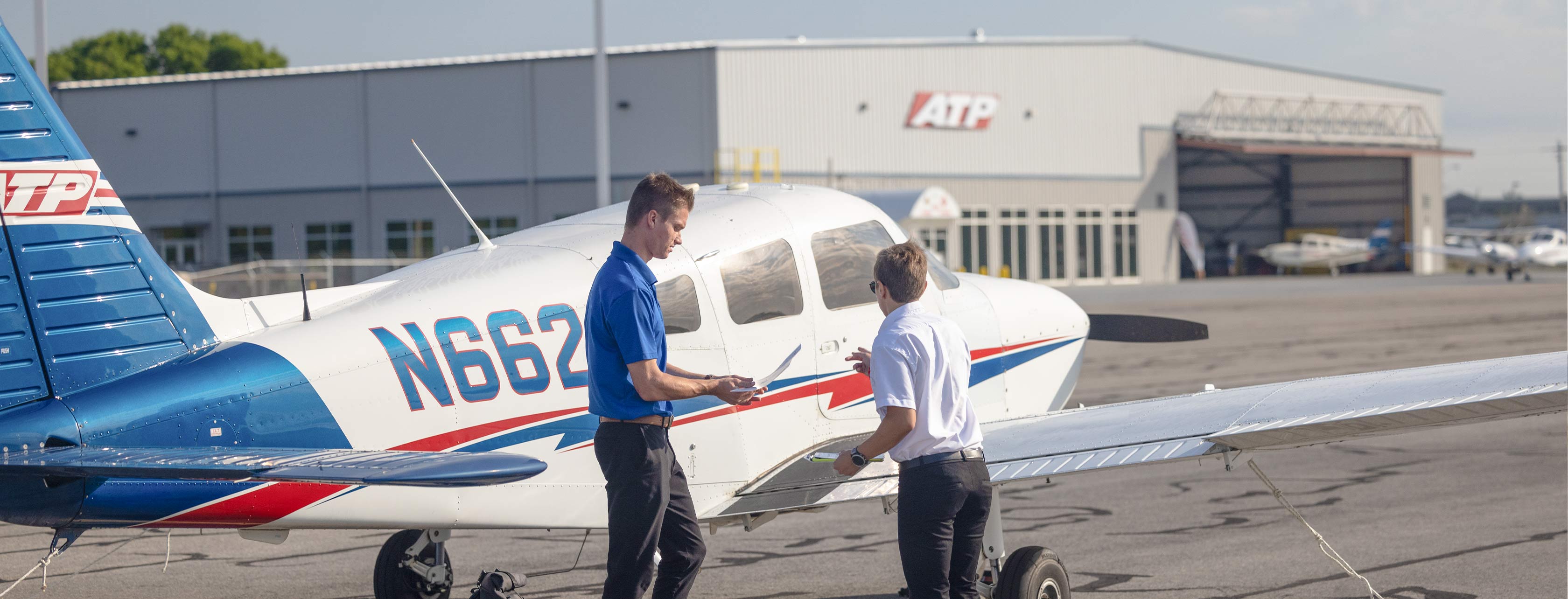
ATP Flight School student and instructor briefing beside a training aircraft

What is a Checkride?

A checkride is the Federal Aviation Administration (FAA) practical test for a pilot certificate or rating. It has two parts—an oral exam and a flight evaluation—administered by a Designated Pilot Examiner (DPE) or FAA inspector and graded to the Airman Certification Standards (ACS) for that certificate or rating.

In plain terms: after you finish the required training and (when required) pass the knowledge test, the checkride is the final FAA evaluation that confirms you can exercise the new privileges safely. Passing earns a temporary airman certificate; failing identifies specific deficiencies to retrain before you retest. For how each certificate fits the career ladder, see how to become a pilot and types of pilot tests.

What Happens During a Checkride?

Expect a structured day, not a surprise quiz. The examiner follows a plan of action aligned to the ACS for the certificate or rating you are testing for.

Becoming a Pilot: What is a Checkride?

ATP Flight School’s short overview walks through what a checkride is and why it matters on the path from first lesson to airline career.

Oral Exam

The oral portion usually happens in a classroom or office. The examiner reviews your application and supporting paperwork, explains the test’s possible outcomes, and questions you on aeronautical knowledge and risk management. Questions are scenario-based when possible and tied to ACS knowledge and risk-management elements—not trivia. If the oral is unsatisfactory, the flight portion does not begin until those deficiencies are corrected and you return for a retest of the unfinished areas.

Flight Evaluation

When the oral is satisfactory, you move to the airplane. The examiner evaluates the full flight: preflight inspection, taxi, takeoff, maneuvers, procedures, navigation or instrument tasks as required, emergencies, and post-flight. You must demonstrate safe operation within the ACS skill tolerances for that certificate or rating. A private pilot checkride emphasizes takeoffs and landings, maneuvers, cross-country navigation, and emergency procedures; an instrument checkride emphasizes instrument flying, holds, and approaches; a commercial checkride tightens tolerances and adds commercial maneuvers.

After a satisfactory checkride, the examiner issues a temporary certificate. The full process can take a few hours to half a day depending on the rating, weather, and how thoroughly the oral runs.

Primary sources: FAA Airman Certification Standards; FAA Training & Testing.

Get Your FREE Personalized Airline Pilot Training & Career Plan

We'll text you a FREE personalized training and career plan — tailored to you, including:

  • Projected Earnings
  • Recommended Program
  • Personalized Timeline
  • Eligibility Checker
  • Repayment Calculator
  • Next Steps

Thank you! We just sent you a text with a link to your personalized airline pilot training and career path.

{{errorMsg}}

No Spam. Opt Out Anytime.

Help us customize your training and career path by answering just a few more questions.

Thank you! We've updated your personalized training and career path with the information you provided. View your Personalized Training and Career Path »

{{ errorMsg }}
Want More Pilot Training & Career Info?

Get helpful emails with insights on what to expect, how to prepare, and what’s next on your path to the airlines

All set! We'll periodically send you information on ATP's programs, the career, and how you can become an airline pilot.

{{ errorMsg }}

Who Administers a Checkride?

Most practical tests for civilian certificates and ratings are administered by a Designated Pilot Examiner (DPE)—a pilot the FAA authorizes to conduct practical tests on its behalf—or by an FAA aviation safety inspector. Your flight instructor trains and endorses you; the examiner is an independent evaluator.

DPE fees are typically paid directly to the examiner and are separate from school tuition. Schools that train many airline-bound students often coordinate examiner availability so checkrides do not become the bottleneck between certificates. ATP Flight School maintains a Flight Checks department and works with DPEs across its nationwide training network so students can schedule practical tests when they are ready.

Whether the examiner is a DPE or an FAA inspector, the evaluation standard is the same: the ACS (or applicable practical test standard) for the certificate or rating sought.

What are Airman Certification Standards?

Airman Certification Standards (ACS) are the FAA’s published testing standards for each certificate and rating. For every area of operation, the ACS lists the knowledge, risk management, and skill elements the examiner may evaluate on the oral and flight portions.

The ACS is the shared plan of action for you, your instructor, and the examiner. Instructors use it to structure training and endorsements; applicants use it to study; examiners use it to grade. For many certificates, the ACS replaced older Practical Test Standards (PTS). Always train and test against the current ACS for the rating you are seeking—not a generic “checkride tips” list alone.

Browse current standards: FAA ACS library.

Which Checkrides are on the Airline Pilot Path?

Airline-bound pilots pass a practical test at each major certificate and rating step. The credentials are the same whether you train under Part 61 or Part 141; the checkride confirms you meet the FAA standard for that step.

Private Pilot Checkride

The private pilot practical test is usually the first full checkride. After required training, the knowledge test, and instructor endorsements, you demonstrate oral knowledge and flight skills for private pilot privileges—the foundation for every later rating.

Instrument Rating Checkride

The instrument rating checkride evaluates instrument flying, cockpit management, holds, and instrument approaches. It is essential for airline-oriented flying and for building the IFR skills commercial and instructor training assume.

Commercial Pilot Checkride

The commercial pilot practical test raises skill tolerances and adds commercial maneuvers. Many airline-path students also add a multi-engine rating, which may involve its own practical test depending on how the training is structured.

Flight Instructor Checkride

The flight instructor practical test evaluates your ability to teach—not only to fly. On the airline path, instructing is a common way to build experience toward the Airline Transport Pilot hour requirements while sharpening standards you will later meet as a professional crewmember.

Each checkride is a gate, not the destination. Map the full sequence with airline pilot requirements.

How Should You Prepare for a Checkride?

Preparation is ACS-driven and instructor-endorsed—not last-minute cramming.

  • Train with the ACS. Use the current ACS as your study and practice outline for knowledge, risk management, and skill elements.
  • Finish prerequisites. Complete required flight and ground training, pass any required knowledge test, and obtain the instructor endorsements that make you eligible to test.
  • Prove consistency. Practice maneuvers and procedures until you meet ACS tolerances repeatedly—not once under ideal conditions.
  • Organize paperwork. Bring a complete, accurate application package. Name mismatches between knowledge-test reports and certificates can stop a checkride before it starts.
  • Know the plan of action. Understand what the examiner will cover orally and in flight so checkride day is familiar, not mysterious.
  • Show up ready. Rest, dress professionally, and treat the day as a professional evaluation—the same standard airlines expect later.

What Happens if I Fail a Checkride?

If you do not pass, the examiner documents the unsatisfactory areas. You retrain those items with your instructor, get a new endorsement as required, and return to finish the test. Structured schools treat a setback as a remediation plan, not an automatic end of training.

How Much Do Checkrides Cost?

Designated pilot examiner fees are paid separately from tuition—usually in cash directly to the examiner—and are not a single fixed price for every checkride. For ATP Flight School’s Airline Career Pilot Program, plan on about $12,000 from zero experience or $10,500 with private pilot credit for FAA examiners’ fees and knowledge test fees across the program. See how much it costs to become an airline pilot for the full cost breakdown.

Where Do Checkrides Fit on My Path to the Airlines?

Checkrides mark progress on the certificate ladder toward airline eligibility. A recreational school may get you through a private pilot checkride; an airline-oriented school prepares you for the full sequence—private, instrument, commercial, multi-engine, and instructor—on a timeline and support model built for career outcomes.

When you evaluate schools, ask how they train to checkride readiness, how they schedule DPEs so practical tests do not stall progress, and whether graduates move into formal airline hiring paths. ATP Flight School’s Airline Career Pilot Program uses standardized instruction, ACS-aligned training, and consistent checkride readiness criteria across its nationwide network. Students and graduates pursue airline-backed Career Tracks™ with American, Delta, and United—formal agreements, not marketing “pathways.” See where to train to become an airline pilot for the school-selection criteria that matter after you understand what a checkride is.

Fly with ATP Flight School Take Your First Flight for Free

When You Apply for a Loan and You're Qualified by Admissions

Learn How »

Piper Archer flying above clouds

Related FAQs Airline Career Pilot Program

What are the eligibility requirements for becoming an airline pilot?
How do I become a pilot?
How do I become a pilot for United Airlines?
How do I become a pilot for American Airlines?
Do I need a college degree to be a pilot?
How long does it take to become a pilot?
How long does it take to become a commercial airline pilot?
What is airline seniority?
What is a regional airline pilot's salary?
How much does it cost to become a commercial pilot?
How can I get a loan for flight school?
What pilot training programs are available?
What are the types of pilot licenses and certificates?
What is a student pilot certificate?
What is a private pilot license?
What is a commercial pilot license?
How to become a certified flight instructor (CFI)?
How to earn your ATP certificate?
How much do airline pilots make?
What is the current airline pilot hiring outlook?
What are the effects of COVID-19 on the airline industry?
What are the eligibility requirements for becoming an airline pilot?

Summary of educational, medical, legal, certification and qualification requirements to become a commercial pilot and fly for major and regional airlines.

What are the eligibility requirements for becoming an airline pilot? »
How do I become a pilot?

To become a pilot in the United States, you must meet FAA eligibility requirements, complete flight training with a certified flight school or flight instructor, and pass FAA knowledge and practical tests.

A common professional path is: Private Pilot → Instrument Rating → Commercial Pilot → Multi-Engine Rating → Flight Instructor (time-building) toward 1,500 total flight hours and airline hiring minimums → Airline Transport Pilot (ATP) certificate at the airline. Most pilots then begin flying for a regional airline as a first officer.

How do I become a pilot? »
How do I become a pilot for United Airlines®?

ATP Flight School is the nation’s leader in airline-oriented flight training and has partnered with United to provide ATP students the fastest path to a successful pilot career with United. Learn more about United AviateSM.

How do I become a pilot for United Airlines? »
How do I become a pilot for American Airlines?

Accelerated pilot cadet program, offering a proven path to a pilot career at American Airlines.

How do I become a pilot for American Airlines? »
Do I need a college degree to be a pilot?

No. A college degree is not required by the FAA to become an airline pilot, and many major and regional airlines do not require one either. Some airlines may prefer or require a degree for certain career programs. ATP Flight School focuses on helping students meet the flight experience and certification requirements that airlines value most.

Do I need a college degree to be a pilot? »
How long does it take to become a pilot?

It takes three months to become a private pilot. In 2½ years , you can become a commercial airline pilot. Learn how you can become a pilot with ATP Flight School.

How long does it take to become a pilot? »
How long does it take to become a commercial airline pilot?

Enroll in accelerated flight training with ATP and go from zero experience to a commercial airline pilot, with 1500 hours, in 2½ years . Learn how you can become an airline pilot with ATP Flight School.

How long does it take to become a commercial airline pilot? »
What is airline seniority?

Airlines operate on a seniority-based system: the pilot employed the longest is highest on the pilot seniority list, and the most newly hired pilot is lowest. When hired, pilots get a seniority number that stays with them throughout their career at that airline.

Seniority determines your monthly schedule and routes, vacation, domicile (crew base), which aircraft you fly, and how soon you upgrade from first officer to captain (affecting pay and when you can move to a major airline). When an airline furloughs, it does so in reverse seniority order. The sooner you are hired, the sooner you start gaining seniority.

Airline seniority explained »
What is a regional airline pilot's salary?

The shortage of pilots qualified to fly for the airlines is causing regional airlines to offer signing bonuses, tuition reimbursement, and other incentives. Learn more about how much you will earn as a pilot.

Compare First-Year Pay at Each Regional Airline »
How much does it cost to become a commercial pilot?

Total cost varies by program, pace, and location. Professional training commonly ranges from tens of thousands to over $100,000 when progressing from private through commercial and instructor certificates.

ATP provides up-front, fixed-cost pricing for the Airline Career Pilot Program and designs programs with enough flight time for the vast majority of students to be successful—never quoting prices based on unrealistic minimum flight time requirements. Fixed-cost pricing does not include separate items such as FAA knowledge tests, designated pilot examiner fees, and third-party iPad apps.

How much does it cost to become a commercial pilot? »
How can I get a loan for flight school?

ATP Flight School students can take advantage of Sallie Mae’s lowest-rate loan product; full financing is available for Airline Career Pilot Program students through Sallie Mae for qualified borrowers. You’re welcome to apply as a standalone applicant, but your application has a better chance of being approved if you apply with a cosigner. Sallie Mae allows students to defer loan repayment while in training and offers an additional 12-month post-graduation grace period.

Complete Guide to Flight School Loans »
What pilot training programs are available?

Complete list of aviation courses, flight training, and career pilot programs offered by ATP Flight School.

What pilot training programs are available? »
What are the types of pilot licenses and certificates?

Uncover everything you need to know about the privileges, requirements, and eligibility criteria associated with different pilot licenses and certifications from the introductory Student Pilot Certificate to the advanced Airline Transport Pilot (ATP) certification.

What are the types of pilot licenses and certificates? »
What is a student pilot certificate?

The student pilot certificate is a requirement in order to fly a powered aircraft by yourself, known as “soloing” in aviation.

What is a student pilot certificate? »
What is a private pilot license?

A Private Pilot License (PPL) is the first major milestone on the road to a career as a pilot. Learn about the private pilot license; including privileges, requirements, eligibility, and how to earn your private pilot license.

What is a private pilot license? »
What is a commercial pilot license?

Learn all about a commercial pilot license, including privileges, requirements, eligibility, and how to earn this pilot license.

What is a commercial pilot license? »
How to become a certified flight instructor (CFI)?

Learn all about earning your flight instructor certification, including privileges, requirements, eligibility, and salary information.

How to become a certified flight instructor? »

Learn all about earning your flight instructor certification, including privileges, requirements, eligibility, and salary information.

How to become a certified flight instructor? »
How to earn your ATP certificate?

An ATP certification will also open a wide array of pilot job opportunities with various corporate and private air carriers. Learn more about the Airline Transport Pilot (ATP) Certification, such as, eligibility requirements and flight experience requirements.

How to Earn Your ATP Certificate? »
How much do airline pilots make?

Flying is a rewarding career, both financially and in terms of job satisfaction. Pilots undertake intensive training to develop a highly unique skill set. As a result, commercial pilots are paid well.

What is a commercial pilot’s salary? »
What is the current airline pilot hiring outlook?

Commercial airline pilot job career information; airline pilot hiring, pilot salary, retirement numbers, military pilot population reduction and the overall upcoming pilot shortage discussion.

What is the current airline pilot hiring outlook? »
What are the effects of COVID-19 on the airline industry?

Long-term pilot career outlook in response to COVID-19, including long term hiring trends, projections, retirements, and the effects of postponing flight training.

What are the effects of COVID-19 on the airline industry? »